If you searched “how to start a waffle business in india”, “how to open belgian waffle franchise” or even “how to start a coffee shop in india”, the steps below apply to all three. If your question is “is waffle business profitable in india”, this guide does not answer it with a returns figure. Profit depends on site, rent and execution, and no honest guide can promise it.
Step 1: Choose your route — independent or franchise
The independent route gives you full control and no franchise fee. It also gives you every problem: batter and menu development, equipment specification, outlet design, supplier negotiation, operating procedures, and training staff into a standard that exists only in your head. Experienced food founders often prefer it; first-time owners underestimate how much of the work is systems, not cooking.
The franchise route trades a fee and an ongoing royalty for a system that already exists — brand, menu, design, equipment specification, suppliers, training, launch support. Models differ too: under active ownership you run the outlet yourself; under FOCO — Franchise Owned, Company Operated, you own it and the company operates it. We compared them honestly in FOCO vs FOFO, including who carries which risk.
Step 2: Choose the format before the location
- Kiosk (roughly 200–300 sq ft): malls, food courts, transit hubs. Takeaway-focused; smallest rent and team; lives or dies on footfall.
- Small café (roughly 300–500 sq ft): high streets and neighbourhood retail, takeaway plus limited seating.
- Standard and flagship cafés (500–1,000 sq ft): commercial districts and premium sites — you pay for seating and visibility, not a bigger menu.
- Cloud kitchen: the cheapest rent, and the worst fit — a waffle's texture is the product, and it degrades in a delivery box.
Those sizes are Boston Waffles & Coffee's four formats, costed in our waffle franchise cost guide. Decide which business you are opening before you fall in love with a shop.
Step 3: Clear the licence stack — in the right order
Food businesses in India operate under a stack of registrations whose set, fees and processing times vary by state, municipality and scale — so this guide names the steps and prints no fee or timeline figures. Confirm current requirements on the official portal or with a local consultant before you budget:
Step 4: Pick the site for footfall, not for rent
- Count the footfall yourself, at the hours you will trade — including weekday afternoons, the dead zone evening counts hide.
- Match the format to the flow. A kiosk needs passing traffic; a café can draw destination traffic but pays for the space.
- Price the whole occupancy cost: deposit, escalations, lock-in, and the fit-out the shell needs.
- Check the premises against Step 3 — water, drainage, power load, and whether the building can be licensed for food.
A cheap site with no footfall is the most expensive site you can take.
Step 5: Equipment and supply — a short list, done properly
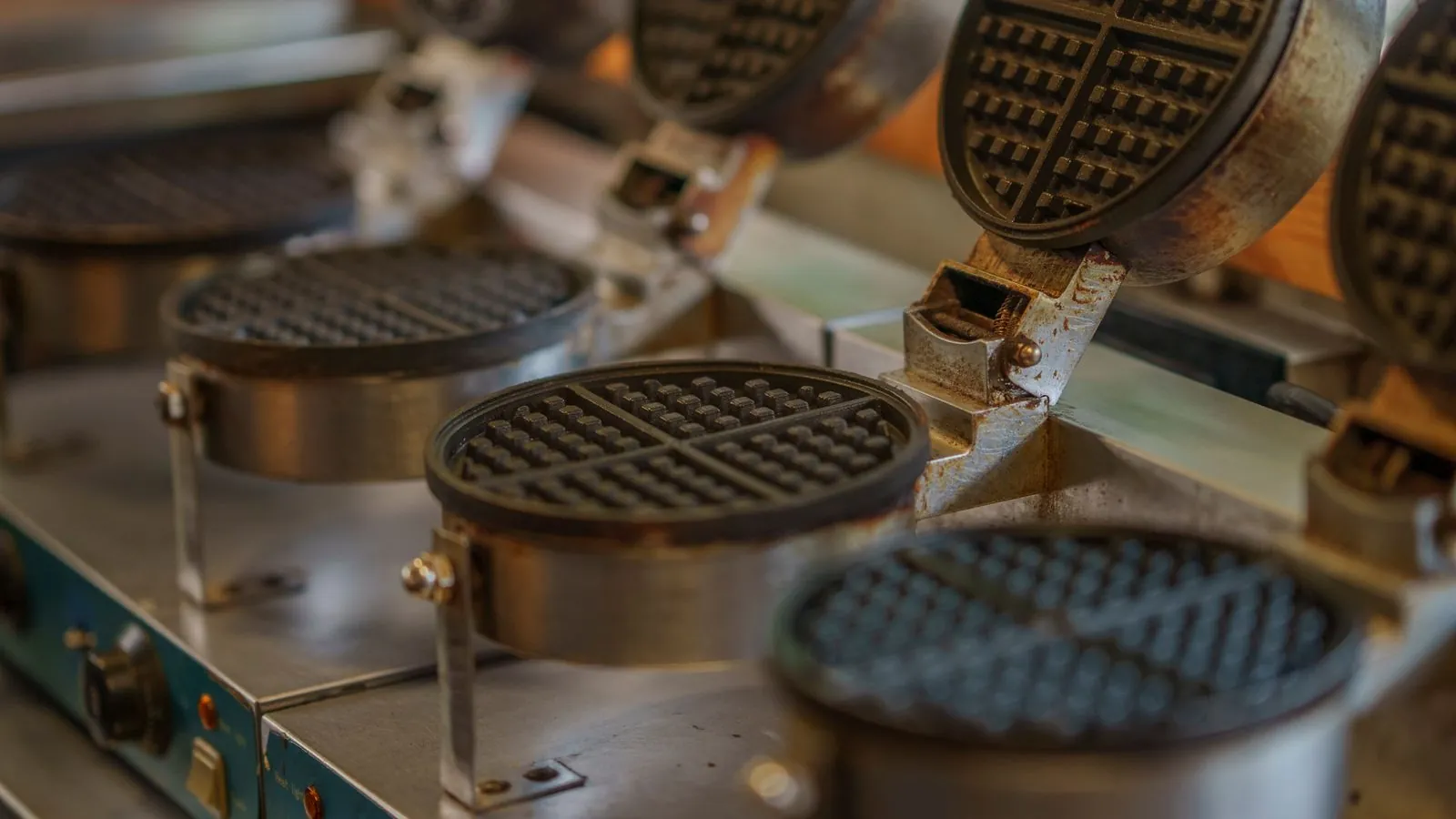
- Waffle irons are the business. Belgian-style irons with deep grids produce the thick, crisp-edged waffle the category is named for; commercial units are not the place to save money. Buy for your peak hour, not your average hour.
- Batter discipline. Fresh-mixed batter gives control; a standardised premix gives consistency across staff and days. Either way the recipe is measured, timed and written down — "a handful of this" is how quality dies.
- The eggless decision. Egg-free eating is a mainstream preference in India, not a niche. Decide your batter policy — fully eggless, or eggless options clearly marked — before the menu is printed.
- Coffee and cold beverages, if your format carries them: an espresso machine and grinder are the big-ticket items. Costs by format are in the coffee shop franchise cost guide.
- Refrigeration, a billing/POS system, food-grade storage — and suppliers who deliver on schedule, with a named backup for what you cannot serve without.
Step 6: Menu and pricing discipline
A waffle menu earns money on focus: core waffles done identically every time, a few signature variations, beverages that support rather than compete. A short menu trains faster, wastes less and quality-controls itself; bloat is how a waffle outlet quietly becomes a bad café. Price from costs, not from the shop next door — cost every recipe to the gram, and redo the arithmetic when ingredient prices move. This guide prints no margins, because honest ones depend on your format, city and contracts; anyone publishing a universal waffle margin is inventing it.
Step 7: Staffing and training
A compact waffle format runs on a lean team — Boston Waffles & Coffee's formats are designed for no more than three — because production is short and repeatable. Lean only works with training: batter mixing, iron timing, finishing, hygiene, and the till, each a written procedure, not a half-remembered demonstration. Under a franchise this step is supplied — under FOCO, the company's team operates the outlet outright.
Step 8: Launch — and the first ninety days
Open in stages: a soft opening lets the team find its rhythm before the launch offer brings a queue. Put the outlet on Google Maps and the discovery platforms customers actually search, with the real menu and real photographs. Local launch marketing — housing societies, offices and colleges in your catchment — outperforms broad advertising at this scale. Then run the first ninety days as measurement: daily covers, average ticket, waste, and the hours that sell.
The mistakes that kill first-year waffle outlets
- Signing the cheap site. Low rent, no footfall, slow death — before the first waffle is sold.
- Buying the wrong format. A café's costs on a kiosk's footfall, or a kiosk asked to do a café's job.
- Inconsistent batter. The product is a texture; when it varies by shift, repeat customers stop repeating.
- Treating licences as later paperwork. The stack is a gate; a premises problem found after signing costs the deposit.
- Budgeting to opening day. Fit-out ends; rent, salaries and supplies do not. Working capital is part of the investment.
- Leading with delivery. A waffle delivered is a diminished waffle; delivery can support a fresh product, never be it.
The franchise route, worked end to end: Boston Waffles & Coffee
- Enquire and do discovery. Submit an enquiry on the franchise page; discovery covers the concept, the investment for your format and city, and what ownership looks like day to day. Our fee and royalty structure is explained line by line there and set out in the agreement before you sign.
- Choose the format and sign the agreement once both sides are aligned: Micro Kiosk (200–300 sq ft), Small Café (300–500 sq ft), Standard Café (500–800 sq ft) or Flagship Café (800–1,000 sq ft), inside the published entry range of US$6,000–$25,000.
- Assess the location together — your site, evaluated against the format (Step 4, with experienced eyes).
- Set up. Design, equipment and fit-out to the system's specification; your licence stack (Step 3) filed in parallel.
- Train and launch. Training and pre-opening preparation are supported by the franchisor's team, with support continuing after opening. If you do not want to operate at all, the founding model is FOCO: you invest and own, the company operates. Active ownership is offered alongside.
The founder has franchised before: Brett Payne, author of The Franchise Freedom Blueprint, spent seven years running franchise operations for Classic Rock Coffee across 12 international markets.
Ready to walk the sequence with the system behind you? Enquire through the franchise form.